

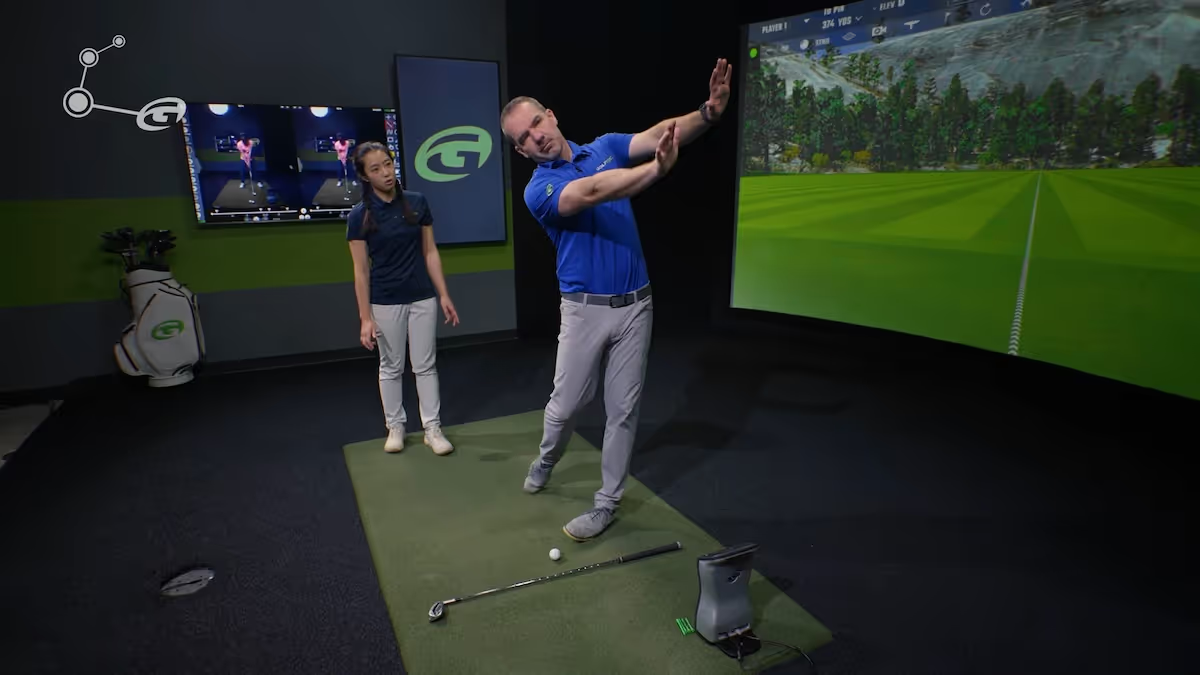
Lead elbow flex refers to the bend in your lead (front) elbow during the golf swing. More flex usually means more inconsistency—causing fat or thin shots. Better players maintain a straighter lead arm by pushing their arms outward throughout the swing, rather than pulling them in toward the body.
Table of Contents:
A swing change can feel comfortable after hitting ten balls with the same club. The next test is whether you can call up the same skill when the club and target change. This game gives you nine chances to find out.
Make a nine-shot card
Choose three clubs and three targets you can see clearly. Write a sequence that mixes them, such as wedge to the near flag, driver to a wide corridor and mid-iron to the middle target. Repeat the pattern using a different target each time. Decide what counts as playable before each shot.
Take one attempt
Stand behind the ball, pick your start line and go through your usual routine. Hit one ball and give yourself one point if it finishes inside the agreed target area. Add a note for your most common miss. Avoid replaying the shot until the end of the game.
Pick the next practice priority
The lowest-scoring club gives you a question for your next session. If you changed targets successfully with your wedge but lost your start line with longer clubs, isolate the longer club for a few repetitions and then return to the nine-shot game.
In Hong Kong, use the game to rehearse a few distances you expect to face on your next round. Explore GOLFTEC Hong Kong.
For more on how the club moves at impact, read Matt Chalmers’s angle of attack guide.

Play the best golf of your life. GOLFTEC Coaches use cutting-edge tech and proven methods to level up your game fast.
Book a Lesson
Play Better!